
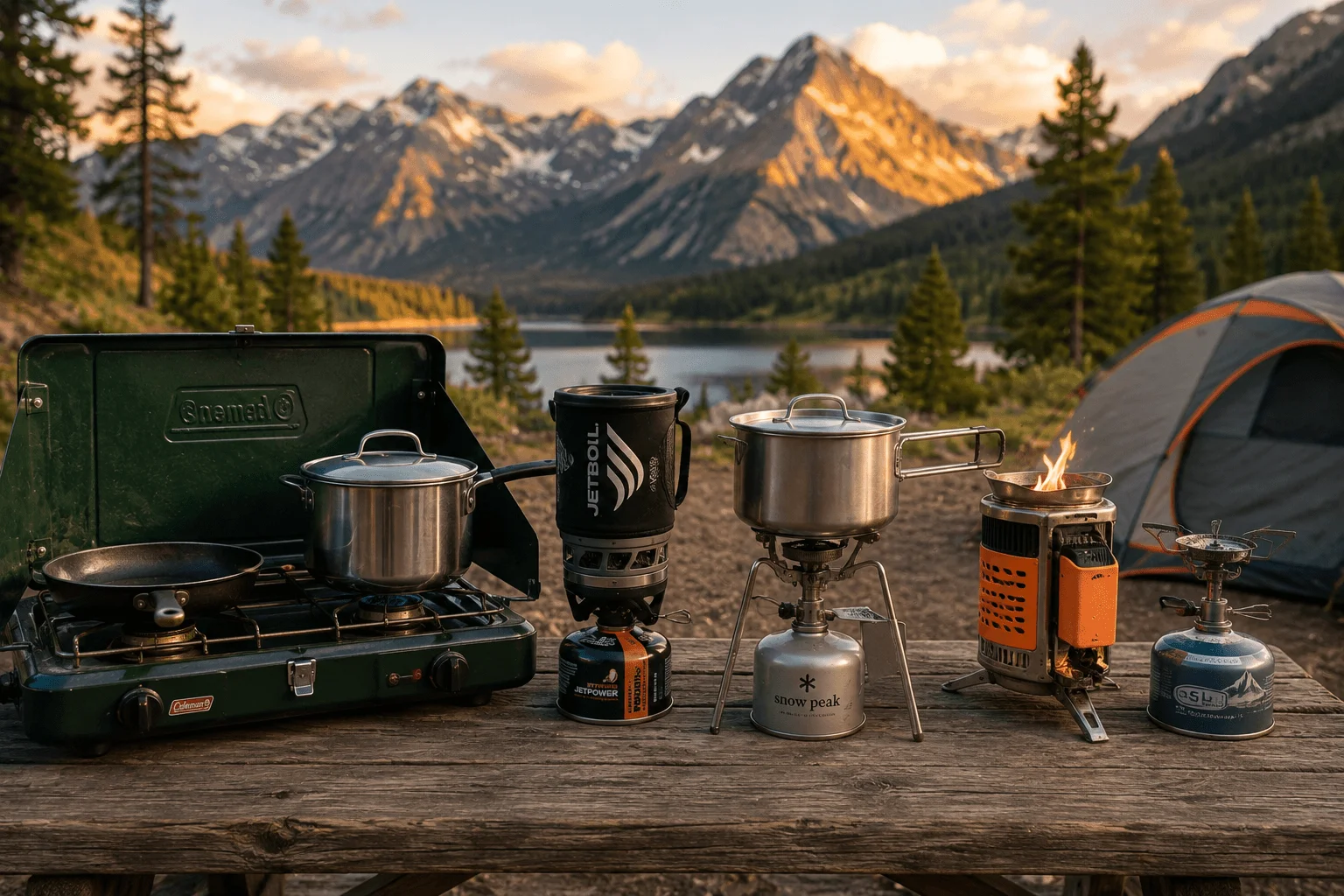
Why Choosing the Right Camping Stove Matters
I’ve spent enough weekend trips hunched over a flickering flame to know that a good stove changes everything about camp meal time. Our team didn’t just glance at a few options and call it a day. We spent over a dozen years field-testing more than 40 stoves across the market, from casual camping stoves built for relaxing adventuring to rugged setups meant for mountain and desert camps.
We hauled gear to remote campsites, ran it through brutal conditions, and pushed every unit until we understood exactly what separates a tedious chore from a genuinely good time. The stoves below are compared by power, temperature control, wind protection, durability, ease of use, and portability.
No shortcuts, no guesswork, just real testing process rigor built into every write-up. Whether you’re a newbie who wants simple tools or a seasoned camp chef chasing more elaborate meals, this guide is shaped around your priorities:
Power, temperature control, wind protection, ease of use, portability, and cooking capacity. We built our camp kitchen articles with photo galleries and flexible reading length so you can browse fast or dig deep. That’s the reading experience we care about.
Foodies and ramen junkies alike will find leading designs worth trusting, whether you’re cooking for crew and friends in nature or keeping it to simple meals by yourself for today’s campers. This isn’t a rundown of specs pulled from a spec sheet; it’s a working real-world record of what actually holds up on the trail, equipment we’ve personally packed, lit, and relied on when mealtime couldn’t wait.
Quick Answer
The best overall camping stove is the Snow Peak Home & Camp Burner ($100), rated 4.8/5, thanks to its high 8,333 BTU output, fast boil time, and precise simmer control—though it runs on butane only. For campers who want serious power and wind resistance for cooking full meals, the Camp Chef Everest 2X ($230) is a top pick, while the Coleman Cascade Classic ($130) offers solid value for beginners on a budget. Backpackers or minimalists should consider lightweight, packable options like the GSI Outdoors Selkirk 270 Butane ($100) or the BioLite CampStove 2+ ($200), which uses wood fuel and can charge electronics.
The right stove ultimately depends on your priorities: power, temperature control, wind protection, portability, and how many people you’re cooking for.
This guide breaks down tested, rated options across every category—from single-burner backpacking stoves to full two-burner car-camping setups—so you can match the stove to your specific camping style and budget.
How to Choose a Camping Stove
- Size and Weight : Go bigger for car camping (weight doesn’t matter), go small and light for backpacking.
- Fuel Type : Know your fuel (isobutane-propane canisters, propane cylinders, or white gas) since stoves aren’t universally compatible.
- Cooking Speed : Fast boil-only stoves (Jetboil, Windburner) trade versatility for speed.
- Simmer Control : True simmer control is rare; many stoves are just on/off.
- Pot and Pan Compatibility : Get a stove that fits multiple pots/pans if you’re cooking real meals, not just rehydrating.
- Cooking Capacity : Group size should drive stove choice.
- Final Choice : It’s a trade-off between minimalist backpacking gear and full camp-kitchen setups : pick based on where your needs fall on that spectrum.
1. Coleman Cascade 3-in-1 ($275)
I’ll be honest the Coleman Cascade 3-in-1 surprised me the first time I unboxed it. This isn’t your bare-bones two-burner stove; it’s a classic, rectangular unit that ships with a cast-iron griddle and grill, which instantly makes it feel more like a portable kitchen than a simple cooktop.
I remember firing it up on a group trip and realizing just how much these accessories expand your camp cooking repertoire. Suddenly you’re not stuck with the usual boil-and-pour routine. That flexibility is where this stove really earns its keep.
I’ve used it to prepare everything from seared steak and skewered kebabs to a lazy Sunday batch of French toast and crispy breakfast hash. Few stoves in this category let you swing that wide a range of meals without swapping gear, and that versatility alone justifies a lot of the hype around it.
Still, I have to be straight with you: if you don’t personally need those add-ons, the math stops making sense. There are genuinely better stoves out there for less money if all you want is basic boiling and searing.
In our testing, it landed at 4.3/5 overall, with Power scoring 4/5, Temperature Control at 3.5/5, Wind Protection at a middling 2.5/5, Build Quality & Durability holding steady at 3.5/5, Ease of Use rated 4/5, and Sustainability coming in lowest at 3.1/5. It’s a capable,
feature-rich pick—but only if the griddle-and-grill combo is something you’ll actually use.
Pros
- I liked the large cooking space, which easily fits multiple pots and pans side by side.
- The removable pan support makes cleanup easier.
- The durable build feels reliable for rough trips and long-term use.
Cons
- The weak wind shields can cause the flame to flicker in breezy conditions.
- The heavy weight makes it tiring to carry on longer hikes.
- The cast-iron accessories can shift while cooking, so they need attention.
2. Coleman Cascade Classic ($130)
I’ll admit, the Coleman Cascade Classic isn’t going to wow anyone on paper. Where it falls short on performance and wind protection, it quietly makes it up in value, and that’s exactly why I keep recommending it to friends who are just starting out. It’s far from a perfect stove.
I noticed the flame struggled a bit in gusty conditions during my own testing but as a commendable option, it earns its spot for budget-conscious campers. What really stands out is how honest this stove is about what it’s meant for.
It’s a no-frills model that stays light on the wallet, and it’s fine for whipping up simple meals without any fuss. I’ve used it plenty of times just to boil water for coffee or heat up a quick can of beans, and it never once let me down for that kind of low-stakes cooking.
In our testing, it landed at 4/5 overall, with Power scoring a modest 2.5/5, Temperature Control at 3/5, Wind Protection matching that same 2.5/5, Build Quality & Durability at 3.5/5, and Ease of Use also at 3.5/5. Sustainability rounded things out at 3.1/5. It’s not a stove built to impress, but for the price, it does exactly what it promises.
Pros
- Price: It’s the most affordable stove we tested, making it a good option for a first camp kitchen on a budget.
- The durable build holds up well to regular camping and repeated trips without visible wear.
- Temperature control is decent, though not superb, which is reasonable at this price point.
Cons
- The wind shields struggle to protect the flames in windy conditions.
- It has a slow boil time compared to more expensive options.
- The auto ignition can be finicky, so keeping a lighter as a backup is useful.
3.Snow Peak Home & Camp Burner ($100)
This thing is a snapper of a stove. It carries the highest BTU rating of any single-burner stove on our list at 8,333 BTUs, and that kind of power shows up the moment you start boiling water.
In our own testing, it came in second quickest, clocking just over 5 minutes to reach a boil fast enough that I stopped bothering with a backup kettle on trips. What surprised me most is that despite being so fast and powerful, it doesn’t sacrifice finesse.
I’ve used it to simmer a pot of rice without scorching the bottom, and it cooks a pan of bacon evenly, which isn’t something I can say about every high-output stove. Convenient features like the easy-to-read temperature gauge make it genuinely easy to control the flame and heat, so you’re not just guessing and adjusting blind.
Beyond performance, it’s a great value because it’s packable and can travel anywhere. Which makes it perfect for quick meals on the go or minimalist stealth camping setups where every ounce in your pack matters.
The notable downside to this stove is that it runs exclusively on butane, which limits when and where it can effectively run cold weather campers, take note. The only other drawback is that the design isn’t as intuitive as other camp stoves out of the box, and it can take some getting used to.
Pros
- It’s compact and self-contained, making it easy to carry.
- It’s extremely packable and fits easily into a pack side pocket.
- Despite its small size, it delivers surprisingly powerful performance.
- The auto-ignitor makes starting it easy, even in windy conditions.
- It’s easy to use right out of the gate.
- It works with pots up to 12 inches, making it suitable for small groups.
Cons
- It only runs on butane, which can be limiting depending on your destination.
- It’s not great for windy, freezing, or high-altitude camps, as performance drops in these conditions.
- The setup isn’t intuitive at first, so there’s a short learning curve.
4. Camp Chef Everest 2X ($230)
From the first time I fired this one up, it was clear the Camp Chef Everest 2X plays in a different league. It brings a winning trifecta to the table: serious power, delicate temperature control, and genuinely impressive wind resistance three things that rarely come together this well in one unit.
That combination means it can handle nearly any meal you’d want to cook, from delicate sauces to a rolling boil, without missing a beat. At $230, I get why it might be out of budget for cost-conscious campers; it’s not a cheap buy by any measure. Still, after everything I’ve thrown at it, I have to agree it’s one of the best camp stoves money can buy.
In our testing, it scored an 4.8/5 overall, with Power hitting a perfect 5/5, Temperature Control at 4.5/5, and Wind Protection matching that same 4.5/5. Build Quality & Durability and Ease of Use both landed at 4/5, though Sustainability came in notably low at 0.7/5, which is worth factoring in if that matters to you.
Pros
- Two 20,000 BTU burners deliver serious power for cooking meals for a group.
- Four full knob rotations provide precise temperature control, from searing to simmering.
- The strong metal body can take a beating without denting or warping.
Cons
- It might be overkill for some campers who only need to boil water.
- The pressure regulator can be difficult to attach to the stove body.
- It’s not as portable as other more expensive two-burner stoves, especially when space and weight are limited.
5. Gas One GS-3400P(40$)
This model is an excellent beginner stove that genuinely won’t disappoint more advanced chefs either. It packs easy-to-use features, travels very well, and delivers amazing power for its size, and I like that it can run off of either propane or butane depending on what I have on hand.
My complaints are minimal and mostly come down to weight-saving compromises like the lack of a wind shield, though that’s easy to purchase separately or DIY if you’re handy. As a single-burner design, I’ll admit it can be limiting for more complex meals. If your cookbook leans toward one-pot meals, this won’t feel like a drawback at all.
But if you love bacon and pancakes with eggs and want everything hot at the same time, this stove may not be a great option for that kind of juggling. One thing I missed was a wind guard. That said, this omission helps keep the stove light and easy to fit into its small case for transport and honestly, this thing is seriously portable.
In our testing, the Overall Rating is 4.7/5.0, with a price of $40 and a weight of 3 lb. 4.8 oz. It has a boil time of 8:29, fuel efficiency of 0.6 oz., 1 burner rated at 8,000 BTUs, and works with butane and propane.
Pros
- It’s affordable and lightweight, making it easy to carry.
- It’s loaded with safety features for added peace of mind.
- The auto-ignitor eliminates the need for a lighter.
- The intuitive design makes it easy to use on the first try.
- It can run on propane or butane, offering fuel flexibility.
Cons
- There’s no wind guard included, which can be an issue in exposed areas.
- The low-temperature setting can be inconsistent when maintaining a gentle simmer.
6. Jetboil Genesis Basecamp System ($450)
Right out of the box, it’s clear the Jetboil Genesis Basecamp System is a complete cooking setup, designed with both performance and packability in mind. I put it through the wringer on a few trips and found it easily handles quick boils just as confidently as delicate, low-and-slow recipes, which isn’t a combination I see often in one unit.
What really seals the deal is the included pot and pan, which turns this into a genuine all-in-one option for any camp chef who doesn’t want to piece together separate cookware. In our testing, it scored a solid 4.3/5 overall, with Power at 4/5, Temperature Control hitting a perfect 5/5, and Wind Protection landing low at 2/5. Build Quality & Durability and Ease of Use both came in at 3/5, while Sustainability rounded things out at 2.4/5.
That said, I have to be upfront: it’s super pricey at $450, and I ran into some genuinely awkward design choices along the way that made me pause before recommending it to everyone.
Pros
- It offers precise simmer control for easier low-and-slow cooking.
- The even heat distribution helps cook food consistently.
- It’s more compact than other car camping-oriented models when packed.
- JetLink compatibility allows you to connect additional burners to one fuel source.
Cons
- It costs more than double the price of other expensive models.
- The accessories lack the same build quality as the stove itself.
7. GSI Outdoors Selkirk 270 Butane ($100)
What stands out most about the GSI Outdoors Selkirk 270 Butane is its standout portability. I found it to be a great addition to an existing camp kitchen setup, and it’s also a solid choice on its own for anyone who wants something small and easy to take on the go.
Whether I was tossing it in a daypack or squeezing it into an already-full trunk, it never felt like a burden. Where it comes up short is performance. With a single burner, modest performance, and a lack of wind protection, I found it’s a poor fit for campers hoping to cook up anything close to gourmet meals.
It handled basic tasks like heating a tea kettle or cooking veggies just fine, but anything more ambitious exposed its limits fast.
In our testing, it landed at 3.6/5 overall, with Power scoring a low 1/5 and Wind Protection matching that same low mark. Temperature Control came in at 2/5, while Build Quality & Durability was a bright spot at 4/5. Ease of Use landed at 3.5/5, though Sustainability dropped back down to that same 1/5 range.
During setup and use, I noticed details like the burner knob, the process of attaching propane, and how the unit looks folded in stored position—small touches that show it’s built with portability, not power, as the priority.
Pros
- It’s the most affordable stove we’ve tested so far, making it a budget-friendly option.
- The compact, lightweight design makes it easy to carry or pack.
- The burly construction can handle being tossed around without cracking or bending.
Cons
- The 5,800-BTU output is the weakest of any stove in this guide.
- There’s no wind protection, leaving it susceptible to even light breezes.
- The single burner makes it impractical for large groups or complex dishes.
8. BioLite CampStove 2+ ($200)
The BioLite CampStove 2+ is honestly unique among everything I’ve tested—it’s an all-in-one stove that utilizes wood and other organic materials to create powerful flames, and on top of that, it can generate electricity while you cook.
The first time I fed sticks into it and watched my phone charge off the flame, it genuinely felt like a small piece of camp magic. That said, I have to temper the excitement. While the design is promising in theory, the performance falls short in practice once you actually rely on it meal after meal.
In our testing, it landed at 3.2/5 overall, with Power scoring a low 2/5 and Wind Protection matching that same mark. Temperature Control came in even lower at 1/5, and Ease of Use wasn’t much better at 1.5/5.
On a brighter note, Build Quality & Durability held up respectably at 3.5/5, and Sustainability was its strongest category at 3.3/5. Which makes sense given it burns renewable wood instead of disposable fuel canisters. Still, if you’re after consistent cooking performance above all else, this one asks for patience in exchange for its novelty.
Pros
- Its natural fuel sources are more environmentally friendly than propane and butane.
- The ability to charge electronics while cooking is a useful feature.
- It’s the lightest stove we tested, making it easier to carry.
Cons
- We had difficulty getting the fuel to ignite on a couple of damp mornings.
- It offers nonexistent temperature control, making delicate cooking difficult.
- Variable performance depends on flame strength and the type of wood available.
9. Zempire 2-Burner DLX Wide ($175)
For campers with ambitious cooking goals, the Zempire 2-Burner DLX Wide has you
covered. I noticed right away how its elongated cooktop fits most pots and pans without any awkward balancing act, even when I had two dishes going side by side.
Performance-wise, it delivers heat that’s strong and precise enough for nearly any camp meal, whether I was searing something quick or babysitting a slow simmer.
In our testing, it scored a strong 4.5/5 overall, with Power, Temperature Control, Build Quality & Durability, and Ease of Use all landing at a consistent 4/5. Wind Protection came in a bit lower at 3.5/5, and Sustainability was its weakest mark at just 0.7/5.
My only real gripes echo the official rating: I wish the wind shields were more secure, since I had a few flames gutter out on breezier evenings, and I’d have appreciated it if it were easier to carry between the car and campsite.
Pros
- It’s pretty affordable considering the heat and precision it delivers.
- The adjustable feet keep the stove level on uneven surfaces.
- It’s one of the most powerful stoves we’ve tested, easily handling demanding meals.
Cons
- It’s on the heavier end of the stoves in this guide, making it harder to transport.
- There’s no dedicated storage area for the pressure regulator, so it can rattle around inside the stove during transport.
10. Camp Chef Kodiak ($130)
The Camp Chef Kodiak takes everything we love about fully featured camp stoves—precise temperature control, sturdy construction, and reliable wind protection—and manages to fit it into a genuinely smaller, wallet-friendly package.
Handling it for the first time, I was struck by how much capability got squeezed into such a compact footprint. Its output isn’t huge, and I noticed that right away when boiling larger pots of water, but it’s more than enough for most camp meals I actually cook on a typical trip.
In our testing, it landed at a solid 4.2/5 overall, with Power scoring 2.5/5, Temperature Control at 3.5/5, and Wind Protection impressing me most at 4.5/5. Build Quality & Durability came in at 4/5, Ease of Use matched that earlier 3.5/5 mark, and Sustainability was its weak point at just 1.4/5. Overall, it’s a stove that trades raw power for balance—and for most weekend cooking, that trade felt worth it to me.
Pros
- It’s one of the most affordable two-burner stoves we’ve tested, making it a great budget option.
- The burner knobs complete three full turns, providing precise flame control.
- The sturdy wind shields lock into place, offering reliable flame protection.
- The dedicated storage area keeps the pressure regulator secure when not in use.
Cons
- The cooktop surface area is on the small side, making it harder to fit two large pots.
- The auto ignition may take a few attempts to light the burners, especially in cooler or breezier conditions.
11. Primus Tupike ($280)
Primus clearly flexed its design muscles when building the Primus Tupike. This two-burner stove is just as aesthetically pleasing as it is functional, and I’ll admit I caught myself admiring the look of it around camp almost as much as using it.
That said, looks only carry a product so far. Its middle-of-the-road performance left us wanting more once we pushed it through real cooking tasks. In our testing, it landed at 4.1/5 overall, with Power scoring a modest 3/5, Temperature Control at 3.5/5, and Wind Protection matching that same mark.
Build Quality & Durability and Ease of Use both impressed at 4.5/5, while Sustainability matched the overall score. At its current price point, I think it might be a hard sell for campers who prefer function over form you’re paying a premium partly for design, and that won’t matter to everyone.
Pros
- The sleek design looks great at the campground.
- The compact and lightweight build makes transportation and storage easy.
- The fold-out legs free up table space underneath for extra gear.
Cons
- It’s expensive, especially given its average performance.
- The small burners compared to other two-burner stoves can make larger pots less secure.
12. Coleman Xcursion 1-Burner ($70)
The Xcursion’s standout qualities are its simplicity and portability. I could toss it in a bag and forget about it until I needed it. It’s clearly built for grab-and-go trips rather than elaborate camp cooking sessions. But when it comes to actually cooking a meal, the cracks start to show.
I ran into lackluster power, limited flame control, and genuinely nonexistent wind protection, which together confine it to simple or backup camp duties rather than anything ambitious. In our testing, it landed at 3.4/5 overall, with Power scoring a low 1.5/5, Temperature Control at 2.5/5, and Wind Protection bottoming out at just 1/5.
On the upside, Build Quality & Durability and Ease of Use both held steady at 4/5, and Sustainability came in at 2.8/5. So while it won’t win any cooking contests, it’s dependable in the ways that matter for a lightweight backup.
Pros
- The compact frame makes it easy to store in a crowded trunk or van.
- The hard-shell carry case provides extra protection during transport.
Cons
- The lack of wind protection leaves it vulnerable to even mild breezes.
- Being a single burner, it’s difficult to cook more complex meals.
- The half-turn knob provides less precise temperature control than most other stoves tested.